A Book About Love by Lehrer Jonah
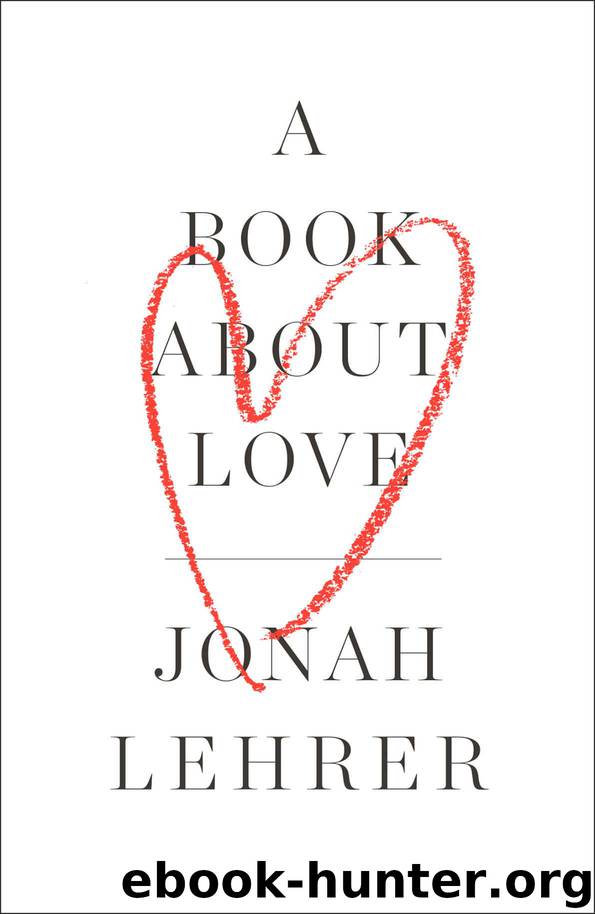
Author:Lehrer, Jonah [Lehrer, Jonah]
Language: eng
Format: azw3
Publisher: Simon & Schuster
Published: 2016-07-11T16:00:00+00:00
* * *
I. According to the scientists, a number of factors caused this decline in friendship, such as the entry of women into the workforce, which leaves less time to participate in volunteer, community, or civic activities. They also blame the Internet: “While these technologies allow a [social] network to spread out across geographic space, they seem, however, to lower the probability of having face-to-face visits with family, neighbors, or friends in one’s home.”
II. Consider an unpublished study led by Bernie Zilbergeld of one hundred married couples. He found that variation in “sexual technique”—what couples actually did in bed, from oral sex to foreplay techniques—explained little of the variation in sexual satisfaction for husband and wife. Instead, Zilbergeld found that the most important factor by far was the maintenance of a close friendship. John Gottman, What Makes Love Last (New York: Simon & Schuster, 2012), 177.
III. The same pattern even applies to “institutional marriages” in the United States. These traditional couples embrace a “norm of marital permanency,” in contrast to the more prevalent “soul mate” model of marriage. (In other words, they believe passionate love is a less important motive for wedlock than child care.) According to a survey of 1,414 married men and women in Louisiana, these institutional marriages typically lead to high levels of marital stability and satisfaction, provided the spouses are “embedded” in large social networks. W. Bradford Wilcox and Jeffrey Dew, “Is love a flimsy foundation? Soulmate versus institutional models of marriage,”Social Science Research 39.5 (2010): 687–99.
IV. The Rubin Love Scale was pioneered by the Harvard psychologist Zick Rubin. It asks people to rate, on a scale of 1 to 9, whether they agree with thirteen statements designed to assess the intensity of their emotional attachment. Sample statements include “If my partner were feeling badly, my first duty would be to cheer him or her up” and “If I could never be with my partner, I would feel miserable.”
V. According to a team of anthropologists, “clear evidence” of romantic love has been found in 147 of 166 studied cultures, from the Bushmen of the Kalahari to the Song Dynasty of China. Most of the exceptions are due to the absence of reliable anthropological evidence, which is quite different from having evidence of an actual absence.
VI. These clichés appear to be largely Western constructions. The late psychiatrist Stephen Mitchell tells a story about the anthropologist Audrey Richards, who studied the Bemba people of Northern Rhodesia. One day, Richards was telling a group of the Bemba “an English folk fable about a young prince who climbed glass mountains, crossed chasms, and fought dragons, all to obtain the hand of a maiden he loved. The Bemba were plainly bewildered, but remained silent. Finally an old chief spoke up, voicing the feelings of all present in the simplest of questions: ‘Why not take another girl?’ ” Stephen Mitchell. Can Love Last? The Fate of Romance over Time (New York: W. W. Norton, 2003), 99.
VII. Two years after Peter Backus wrote that paper explaining why he would never find a suitable partner, he fell in love and got married.
Download
This site does not store any files on its server. We only index and link to content provided by other sites. Please contact the content providers to delete copyright contents if any and email us, we'll remove relevant links or contents immediately.
Doing It: Let's Talk About Sex... by Hannah Witton(9257)
Thirteen Reasons Why by Jay Asher(8861)
The Girl Without a Voice by Casey Watson(7855)
The Incest Diary by Anonymous(7650)
Should I Stay or Should I Go? by Ramani Durvasula(7632)
The Lost Art of Listening by Michael P. Nichols(7467)
The Leavers by Lisa Ko(6933)
The Space Between by Michelle L. Teichman(6903)
The Testaments by Margaret Atwood(6854)
The Four Agreements by Don Miguel Ruiz(6721)
Rich Dad Poor Dad by Robert T. Kiyosaki(6546)
The Rosie Project by Graeme Simsion(6326)
Beartown by Fredrik Backman(5696)
We Need to Talk by Celeste Headlee(5590)
Ego Is the Enemy by Ryan Holiday(5370)
Men In Love by Nancy Friday(5209)
Spare by Prince Harry The Duke of Sussex(5153)
Hunger by Roxane Gay(4902)
Suicide Notes by Michael Thomas Ford(4802)
